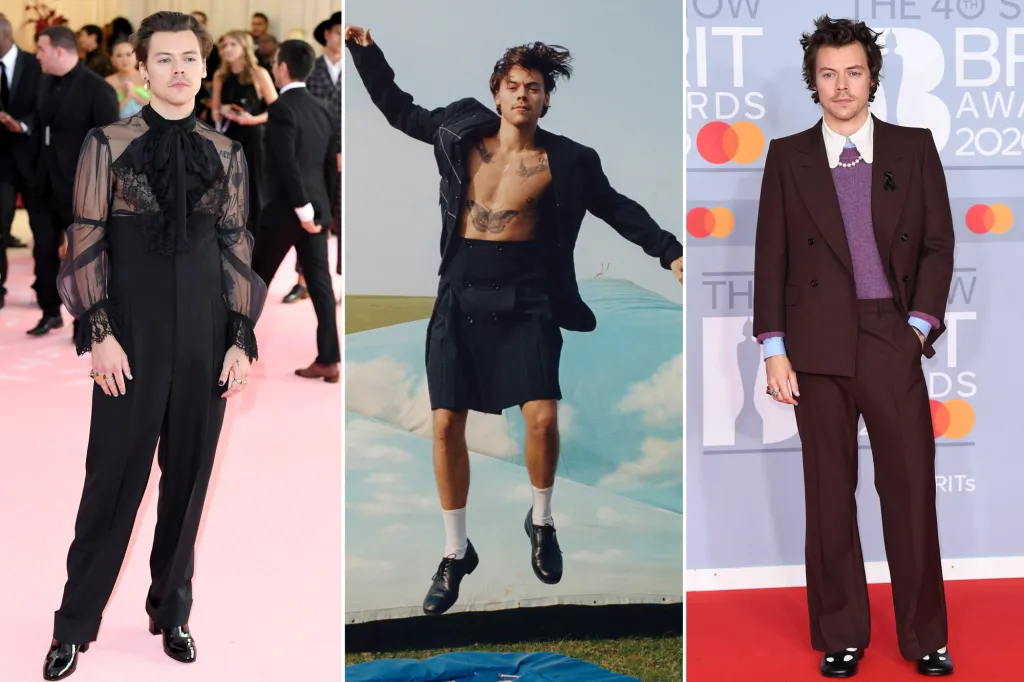
Harry Styles’ 2020 Vogue cover, in which he wore a Gucci gown, became a genuine flashpoint in mainstream fashion conversation — not because gender-nonconforming fashion was new, but because the scale of his visibility as a mainstream pop star put the discussion in front of an audience that hadn’t necessarily engaged with it before. The cover generated significant public debate, and Styles addressed the reaction directly in subsequent interviews, framing his approach to clothing as simply about what he finds interesting rather than a deliberate political statement.
His ongoing collaboration with Gucci’s then-creative director Alessandro Michele produced a consistent visual language across red carpets, tour costuming, and music videos — sheer fabrics, ruffled collars, and traditionally feminine silhouettes worn without any attempt to butch them up for a male audience — that gave his gender-fluid styling a coherence rather than feeling like isolated shock-value choices.
That consistency mattered for how the fashion industry responded: rather than treating his choices as a one-off cover moment, brands and stylists began actively pitching similar gender-fluid options to other male artists, and menswear coverage broadly started treating skirts, pearls, and traditionally feminine tailoring on men as a legitimate trend rather than a novelty confined to one artist.
The lasting impact isn’t that gender-fluid fashion became universal on red carpets — it remains a minority choice among male celebrities — but that it stopped being treated as automatically newsworthy on its own, a shift in normalization that fashion critics consistently trace back to the sustained visibility of his specific styling choices.