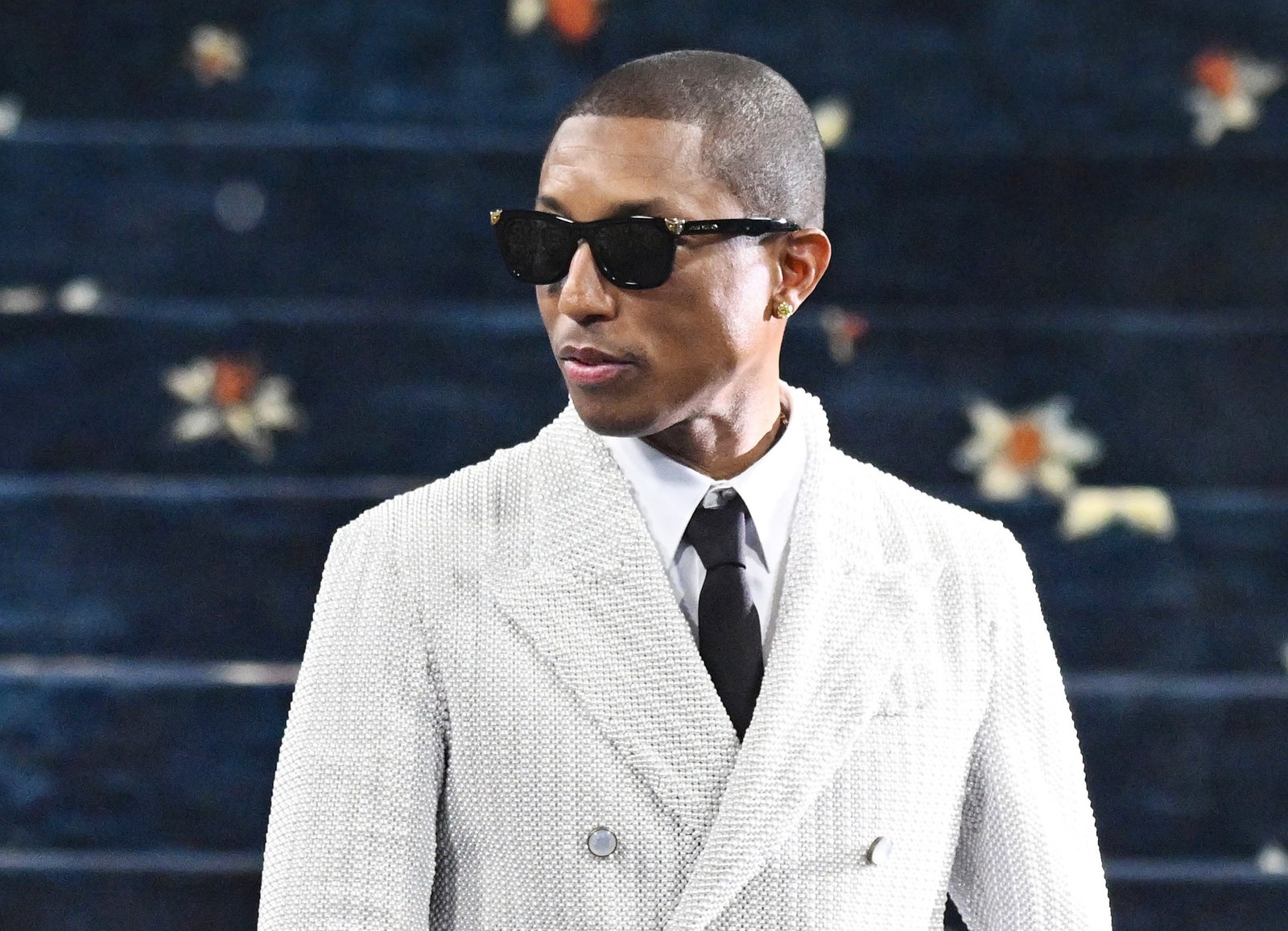
Pharrell Williams has been unusually consistent, across interviews spanning his time in The Neptunes, N.E.R.D., his solo career, and his fashion work, in describing music and design as coming from the same place rather than separate disciplines he happens to practice. He’s said repeatedly that he approaches a fashion collection with the same instinct he uses to build a beat — starting from a feeling or a color rather than a formula — which has become a consistent talking point across profiles covering both sides of his career.
Around his appointment as Menswear Creative Director at Louis Vuitton, his interviews leaned heavily into the idea of using the role to open doors for other Black creatives in luxury fashion, a theme he’d already discussed for years in the context of his Something in the Water festival and various mentorship initiatives. He’s framed the Louis Vuitton position less as a personal achievement and more as evidence that the industry’s gatekeeping was changing.
On the music side, he’s spoken often about staying deliberately unattached to any single genre, citing his work across hip-hop, pop, and even country collaborations as proof that a good idea doesn’t belong to one category. Interviewers have also noted his tendency to describe decades-old hits, including “Happy,” in almost spiritual terms — describing songwriting as a kind of channeling rather than a purely technical process.
Across both industries, the throughline in his interviews is remarkably stable: an insistence that creative instinct, not genre or medium, is the actual skill, and that the specific output — a song or a jacket — is secondary to that underlying instinct.